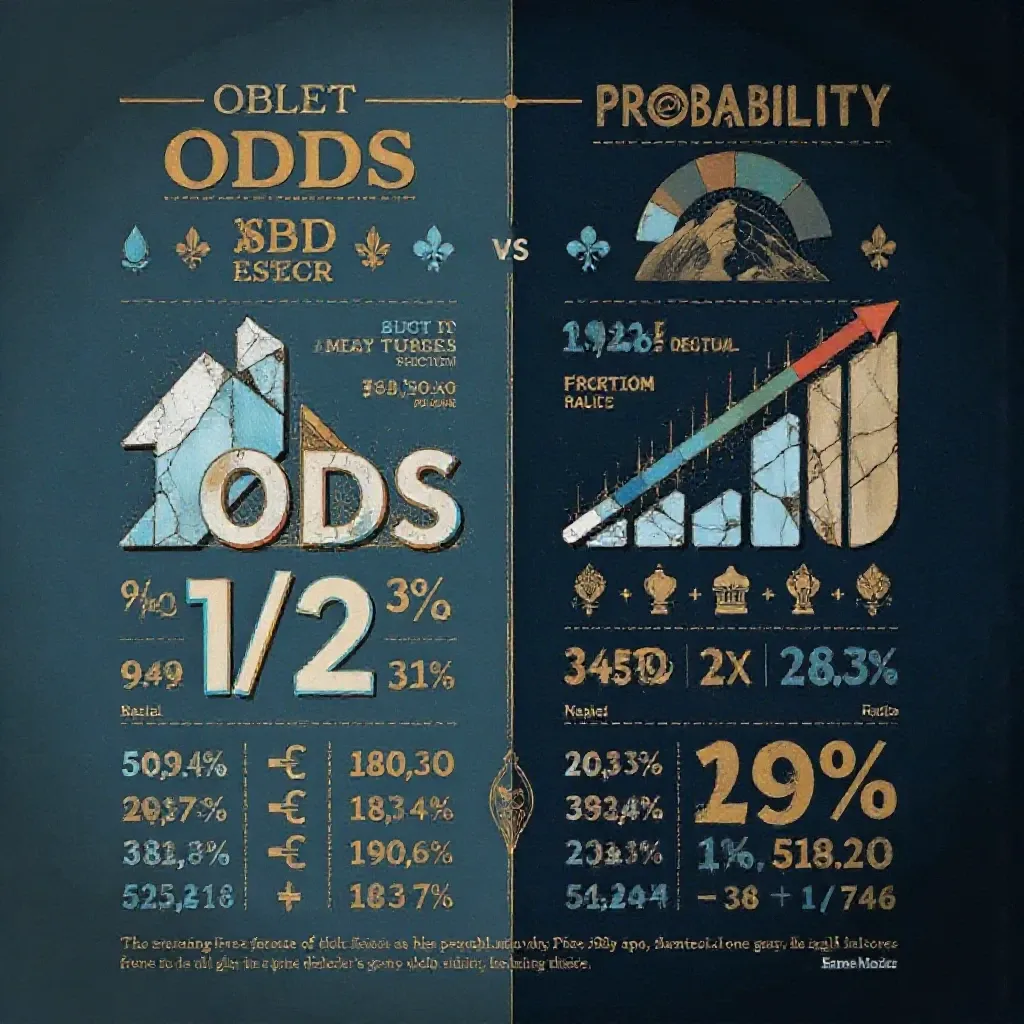
Imagine watching a nail-biting sports game. The commentators throw around phrases like “the odds are in their favor” or “the probability of winning is high.” But what do these phrases reallymean*? Are odds and probability the same thing? In everyday conversation, the terms are often used interchangeably, leading to confusion.
This article cuts through the jargon and explains the core difference between odds and probability in a clear, straightforward manner. Think of probability as a simple way to express the chance of an event occurring. Odds, on the other hand, show the relationship between the chances of an event happening versus it not happening.
Having navigated the world of statistics and data analysis, experience shows how crucial it is to understand these subtly different concepts. From interpreting medical research to making informed investment decisions, or even just understanding the likelihood of rain, grasping the distinction between odds and probability empowers people. These concepts are commonly used in sports, finance, gambling and insurance.
Defining Probability
Probability is a numerical measure that expresses the likelihood of a specific event occurring. It’s a fundamental concept used to quantify uncertainty and predict the chances of different outcomes. The higher the probability of an event, the more likely it is to happen; conversely, a lower probability suggests the event is less likely.
The basic probability formula is surprisingly straightforward. It’s calculated by dividing the number of favorable outcomes (the outcomes you’re interested in) by the total number of possible outcomes. Expressed mathematically:
Probability = (Number of favorable outcomes) / (Total number of possible outcomes)
Let’s illustrate this with a couple of simple examples. If you flip a fair coin, there are two possible outcomes: heads or tails. The probability of getting heads is 1 (one favorable outcome) divided by 2 (two total outcomes), resulting in a probability of 0.5 or 50%. Similarly, when rolling a standard six-sided die, the probability of rolling a specific number, say a 4, is 1 (one favorable outcome) divided by 6 (six total outcomes), which equals approximately 0.167 or 16.7%. Keep in mind that any probability result will always land between 0 and 1, offering a relatable scale to measure possibility.
Understanding Probability Values
Probability values provide a clear understanding of an event’s likelihood. A probability of 0 signifies an impossible event; something that simply cannot occur. For example, the probability of drawing a red card from a deck of only black cards is zero.
On the opposite end of the spectrum, a probability of 1 indicates a certain event; something guaranteed to happen. The probability that the sun will rise tomorrow is practically 1 (barring any astrophysical anomalies!).
A probability of 0.5, or 50%, represents an event that is equally likely to occur or not occur. As we saw with the coin flip, there’s a 50% chance of landing on heads and a 50% chance of landing on tails. This balanced likelihood makes these probabilities particularly interesting.
Defining Odds
In its simplest form, “odds” represents a numerical expression of the likelihood of a specific event occurring. It quantifies the relationship between the probability of an event happening versus the probability of it not happening. Essentially, it’s a way to gauge how favorable the chances are for a particular outcome.
The odds formula provides a concrete method for this calculation. It can be expressed in a couple of ways, and both boil down to the same core concept:
- (Probability of event occurring) / (Probability of event not occurring)
- (Number of favorable outcomes) / (Number of unfavorable outcomes)
The resulting figure is then typically expressed as a ratio, such as 3:1, 1:2, or 5:2. This ratio allows for quick interpretation of the likelihood. For example, odds of 3:1 suggest that the event is three times more likely to occur than not occur.
Understanding Odds Ratios
Decoding odds ratios is key to fully grasping the concept of odds. An odds ratio of 1:1 indicates an interesting point: the event is just as likely to occur as it is not to occur. Think of it as a coin flip where both outcomes have equal chances. When the initial number is higher than the second (e.g., 2:1, 5:3), the event is more likely to happen than not. Odds such as 2:1 translate to the event being twice as likely to occur versus its non-occurrence. Conversely, whenever the first number is smaller than the second (e.g., 1:3, 2:5), the event is less likely to occur than not. So, odds like 1:3 represent a situation where something is three times less probable than it is not.

Key Differences Between Odds and Probability
While often used interchangeably, odds and probability are distinct concepts with different mathematical representations and interpretations. Understanding these differences is crucial in various fields, from statistics to gambling.
Probability expresses the likelihood of an event occurring as a fraction or decimal between 0 and 1. A probability of 0 indicates impossibility, while a probability of 1 signifies certainty. It represents the event’s chance relative to all possible outcomes. For example, the probability of flipping a fair coin and getting heads is 0.5, meaning there’s a 50% chance of that outcome.
Odds, on the other hand, are expressed as a ratio of the probability of an event occurring to the probability of it not occurring. So, unlike probability, odds compare the number of ways an event can happen to the number of ways it cannot. If the probability of an event is P, the odds in favor are P / (1-P), and the odds against are (1-P) / P. Using the coin flip example, the odds of getting heads are 1:1 (one way to get heads, one way to get tails).
Here’s a table summarizing the key distinctions:
| Feature | Probability | Odds |
|---|---|---|
| Expression | Fraction or Decimal (0 to 1) | Ratio |
| Interpretation | Likelihood relative to all outcomes | Likelihood relative to non-occurrence |
| Range | 0 to 1 | 0 to infinity |
When to Use Odds vs. Probability
The choice between using odds and probability often depends on the context and the information you want to convey.
Probability is frequently used in scientific research, risk assessment, and situations requiring a clear understanding of overall likelihood. For example, a doctor might say there’s a 90% probability of successful treatment. This provides a general sense of the treatment’s effectiveness.
Odds are prevalent in gambling and scenarios where comparing success to failure is more relevant, like in sports betting. If a bookmaker gives odds of 5:1 on a horse winning, it means they predict the horse will lose five times for every one time it wins. Odds are easier to translate into potential payouts and perceived value in these contexts. Another example, a doctor might say the odds of surviving are 10:1. It can be especially encouraging, as it puts a positive spin.
Converting Between Odds and Probability
Understanding the relationship between odds and probability is crucial in various fields, from gambling and sports betting to risk assessment and scientific analysis. While both concepts express the likelihood of an event occurring, they do so in different ways. This section provides practical guidance on how to convert between odds and probability, enabling you to interpret and utilize data more effectively.
The conversion from odds to probability uses the following formula: Probability = Odds / (Odds + 1). Conversely, converting from probability to odds is done using this formula: Odds = Probability / (1 – Probability). These formulas are essential tools for anyone needing to translate between these two representations of likelihood.
Step-by-Step Conversion Examples
Let’s walk through some examples to illustrate the practical application of these formulas. Consider a horse race where the odds of a particular horse winning are 3 to 1 (often written as 3/1). To convert these odds to probability, we use the formula: Probability = 3 / (3 + 1) = 3 / 4 = 0.75. This means there’s a 75% chance of the horse winning.
Now, let’s look at an example of converting probability to odds. Suppose a medical study indicates that a patient has a 20% (or 0.2) chance of developing a certain side effect from a medication. To convert this to odds, we use the formula: Odds = 0.2 / (1 – 0.2) = 0.2 / 0.8 = 0.25, or 1/4. So the odds of the patient developing the side effect are 1 to 4.
Another example: imagine the odds of a soccer team winning a match are 1/2. To convert this into probability: Probability = 1 / (1+2) = 1 / 3 = 0.333, which is 33.3%
Lastly, if a weather forecast predicts an 80% chance of rain: Odds = 0.8 / (1-0.8) = 0.8 / 0.2 = 4, or 4/1. The odds of such event are 4 to 1.
Practical Applications
The concepts of odds and probability aren’t confined to textbooks; they’re actively used across various sectors, influencing decision-making in significant ways. Recognizing the distinction between them can provide a tangible edge.
Gambling
In gambling, particularly in horse racing and poker, understanding odds is pivotal. Odds represent the ratio of unfavorable outcomes to favorable ones. For instance, odds of 5:1 against a horse winning suggest that for every one chance of winning, there are five chances of losing. Gamblers use this information to assess potential payouts and determine if a bet is worthwhile. Probability, on the other hand, would express the horse’s chance of winning as a percentage. Confusing the two can lead to misjudgments and poor betting strategies. Skilled gamblers often convert probabilities into odds to compare them against bookmakers’ odds, seeking discrepancies that offer value.
Finance
The finance industry relies heavily on probability and, indirectly, on odds for investment risk assessment. While financial models primarily use probabilities to forecast market behavior and the likelihood of specific events (like a stock price increase), the underlying risk assessments often consider odds. For example, an analyst might determine the probability of a company defaulting on its debt. This probability can then be translated into odds, which are used to price credit default swaps or other risk-mitigation instruments. A higher probability of default translates to higher odds against repayment, leading to higher costs for insuring against that risk. Understanding these nuances is crucial for managing portfolios and pricing financial products effectively.
Science and Medicine
In science and medicine, especially in interpreting clinical trial results, both odds and probability play vital roles. Researchers often use odds ratios to compare the likelihood of an event occurring in one group versus another (e.g., the odds of developing a disease among those exposed to a certain factor versus those who weren’t). Probability is used to express the overall chance of an event occurring within a population. For example, a clinical trial might report that a drug reduces the probability of heart attack by 20%. This can be further analyzed using odds ratios to demonstrate the relative impact of the drug. Misinterpreting whether a study reports an odds ratio or a probability change can lead to incorrect conclusions about the effectiveness of a treatment. Accurately discerning these measures is paramount for evidence-based decision-making in healthcare.
Common Mistakes and Misconceptions
Navigating the world of odds and probability can be tricky, even for those with a good head for numbers. Several common mistakes and misconceptions can lead to miscalculations and poor decision-making. One frequent error lies in confusing the formulas for odds and probability. Probability is the chance of an event occurring, expressed as a fraction of the total possible outcomes, while odds compare the likelihood of an event happening to the likelihood of it not happening.
Misinterpreting odds ratios is another pitfall. An odds ratio indicates how much more likely one event is compared to another. For instance, an odds ratio of 2 doesn’t mean a 50% chance; it means the event is twice as likely to occur. Furthermore, people often incorrectly apply probability in real-world scenarios by failing to account for all relevant factors or assuming independence when it doesn’t exist. For example, in finance, past performance isn’t a guarantee of future results because market conditions are constantly changing.
The ‘gambler’s fallacy’ is a particularly persistent misconception. It’s the belief that if something happens more frequently than normal during a given period, it will happen less frequently in the future, or vice versa. The reality is that many events, especially in games of chance, are independent, meaning past outcomes don’t influence future ones. To avoid these mistakes, it’s crucial to clearly understand the definitions and formulas for odds and probability. Always consider all relevant factors and avoid the trap of believing in patterns where none exist, especially when dealing with random events. By staying informed and thinking critically, you can improve your understanding and make more informed decisions.
Advanced Concepts (Optional)
Beyond the basics of odds and probability, more advanced mathematical tools offer deeper insights into predicting and understanding events. Bayes’ Theorem, for example, provides a framework for updating probabilities as new evidence becomes available. Imagine estimating someone’s likelihood of relocating based on their job search history; discovering they’ve attended an out-of-state job fair would significantly alter that initial probability.
The concept of Expected Value utilizes probabilities to forecast the average outcome of a decision if it were repeated many times. Businesses frequently use expected value to evaluate potential investments, weighing the probability of success against the potential financial reward. Moreover, sophisticated risk assessment models combine odds and probability with other factors to provide comprehensive evaluations. These models are employed in various fields, from finance to engineering, to make informed decisions in the face of uncertainty.
Conclusion
In summary, odds and probability, while related, are distinct concepts. Probability expresses the likelihood of an event occurring relative to all possibilities, whereas odds compare the likelihood of an event occurring to it not occurring. Understanding this difference is vital for making informed decisions, whether in finance, gaming, or everyday life. Now equipped with this knowledge, it is time to apply it and sharpen your analytical skills.